- Blog
- Test article for Dora
Test H1 for practice article
This is where the meta description goes in italic.
As a vehicle trader, you often need to balance speed, paperwork, and total costs. When a vehicle crosses a border, the required documents can affect how smoothly the process runs and how predictable the final numbers are.
For that, you may need a supporting document issued as part of the export/import process.
In this practice article, you’ll learn what a customs support document is in general terms, when it can be relevant, and what you should confirm before you rely on it, so you can plan your exports with fewer surprises.
What is a customs support document?
A customs support document is an official form used during export and import procedures.
It can be requested by authorities to support information in a shipment, in this case a vehicle, such as declared values, route details, or origin-related statements under certain administrative frameworks with non-member countries.
For example, if you’re exporting to a destination that has specific import formalities, customs may ask for certain proof or supporting forms during checks.
It’s important to remember that a support document does not apply to every export and does not guarantee a specific outcome in all cases.
► Who prepares it?
When you export vehicles, some documents can be prepared by the buyer or seller. Some documents, like a basic export filing, may be prepared by the party responsible for the customs submission.
So, who prepares a customs support document?
In practice, specialized customs, forwarding, or transit agencies often prepare supporting paperwork.
These are often the same agencies that handle transport coordination, temporary registration, or border paperwork for exported vehicles.
Many buyers work with a local transit provider and receive required supporting documents through that provider.
In Belgium, you can choose from several transit and shipping agencies:
- Example Transit Provider A
- Example Logistics Provider B
- Example Customs Agency C
- Example Freight Provider D
- Example Forwarder E
❗Disclaimer: Keep in mind that services can vary a lot depending on the agency. Some may not handle certain transport methods or used passenger vehicles. Still, these are established service provider types, so it can be worth contacting them to confirm whether they can support your route and paperwork.
This practice article does not verify service availability for any agency listed above. Names and links are placeholders.
After the paperwork is prepared, authorities may check and validate it during the customs process, which makes it officially usable.
In some cases, you can request certain documents directly from the customs office in the exporting country.
Under some administrative frameworks, customs authorities issue specific forms when the exporter requests them and provides the required supporting evidence.
The process can differ depending on the country. Generally, it may be safer to arrange the paperwork through an experienced transit/customs agency, or check the exact requirements with customs before import.
Why does this document matter for vehicle traders?
This paperwork isn’t always straightforward, but many traders still arrange it because it can reduce delays, clarify checks, or prevent complications at import.
Exporting vehicles from one customs area to another can get expensive and time-sensitive, as import procedures may include duties, taxes, inspections, or deposits. That’s why many traders focus on routes with predictable requirements.
But if a supporting document can help avoid additional steps or reduce certain charges in a specific case, cross-border exports can become more manageable.
List of countries where additional paperwork may be requested
Here’s a practice list of countries where import authorities may request additional supporting documents, grouped by region.
|
Region |
Country |
Helpful links |
|
Europe (non-EU members) |
Example land A |
|
|
Example land B |
||
|
Example land C |
||
|
Example land D |
||
|
Example land E |
||
|
Example land F |
||
|
Example land G |
||
|
Example land H |
||
|
Middle East & North Africa |
Example land I |
|
|
Example land J |
||
|
Example land K |
||
|
Example land L |
||
|
Example land M |
||
|
Example land N |
||
|
Example land O |
||
|
Eurasia |
Example land P |
|
|
Example land Q |
Remember, if you see that your destination country is on this list, that’s still not a guarantee that the local authorities will accept a specific document or apply a specific rule.
❗You should always confirm the rules with the local customs before import!
EU countries - extra customs paperwork not needed for internal EU trade
If you’re trading vehicles between EU members, you generally don’t need additional customs documents. Goods move freely within the EU, and no customs duty applies.
Vehicle requirements for supporting documents
If you want to prepare certain supporting documents, you may need to show evidence about the vehicle, such as where it was produced or how it was originally placed on the market.
For this, you may need a declaration from the exporter, or an official document from the manufacturer, depending on the destination’s requirements.
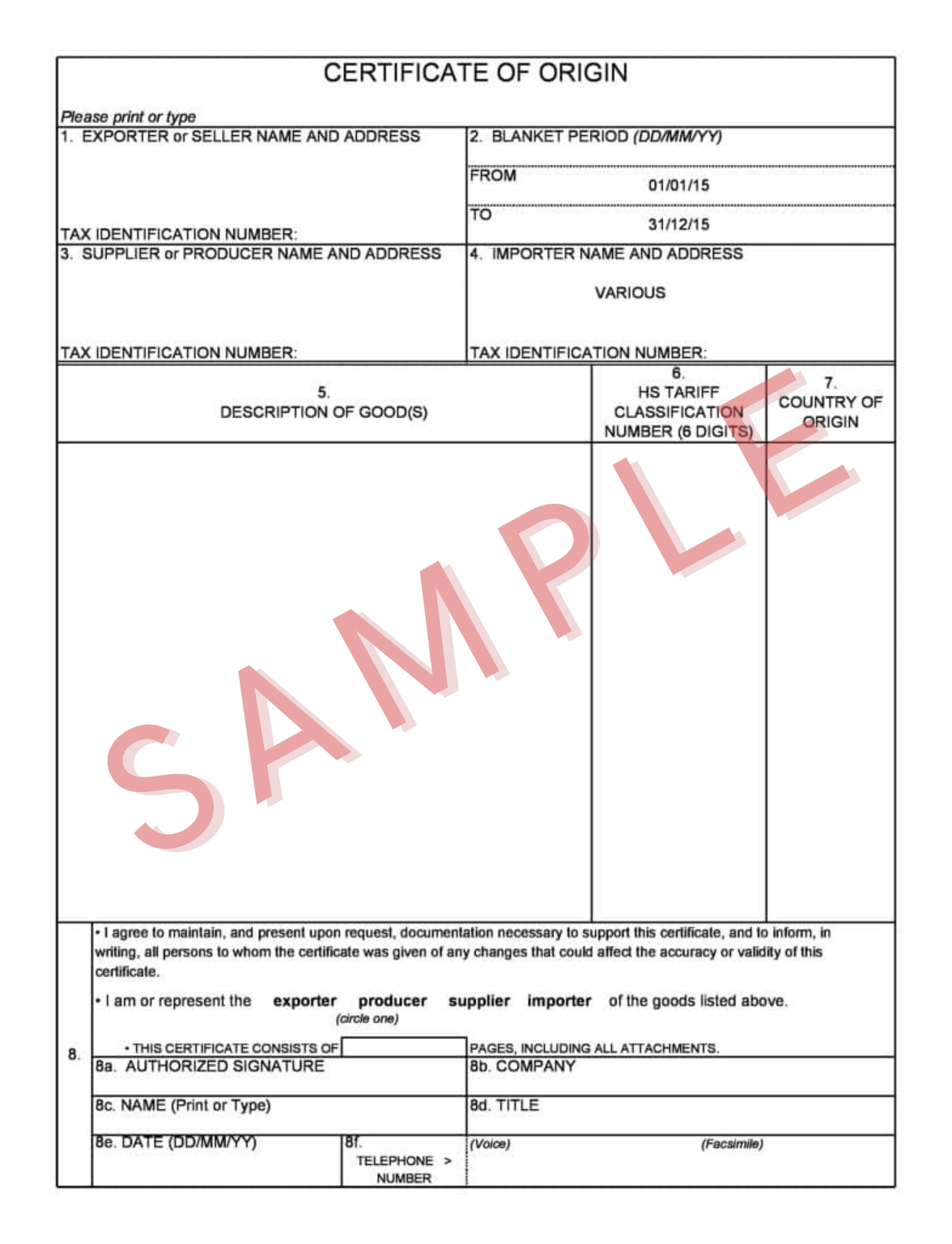
Example of a supporting document (illustration)
Alternative documents as a starting point
In some workflows, an alternative document may confirm a specific vehicle detail, but it may not be the same as the document requested by customs.
In some cases, you may be able to request a supporting document through the supplier you’re buying from. Availability depends on the vehicle and the supplier’s process.
For instance, if you’re buying vehicles from a supplier selection page, the supplier may sometimes provide a supporting document on request. In a real process, you would confirm availability before planning the export.
So, getting a supporting document can be the first step towards completing the export file. Still, you should keep in mind that:- Not every manufacturer provides additional documents
- Availability depends on the brand and the vehicle
How to prepare export paperwork?
Here’s a general overview of how export paperwork is usually handled. The exact process depends on the exporting country and the destination country, so the steps below are only a guide.
1. Confirm destination requirements
The first step is to check what the destination country requires for import and which documents are expected.
2. Decide which supporting proof you will use
Check which documents you can obtain (from the supplier, exporter, or manufacturer) and which ones your service provider can submit.
To do this, you’ll have to contact either:
- The exporter,
- A transit agency,
- Or the manufacturer.
3. Prepare the export file
If you decide to work with a transit agency, you’ll usually prepare documents such as:
- Vehicle purchase invoice
- Registration papers
- ID or passport of the importer
- Supporting document (or other evidence accepted for your route)
7. Pay import costs (if required)
How you’ll pay import-related costs depends on the destination country.
In some countries, costs are settled immediately at import.
In other countries, such as destinations that use a deposit approach, authorities may require a deposit even if you provide complete documentation.
In many cases, you may be able to apply for an adjustment later when the file is reviewed, but adjustments are not automatic and can take time.
So, you should check in advance how import payments work in your destination country.
8. Keep document copies
After import, keep copies of the paperwork and supporting documents because authorities may request additional checks later.
Planning exports with fewer surprises
Good documentation can take effort, but it helps reduce delays and makes costs easier to estimate.
However, the most important step is to confirm requirements early and check what is realistically available for the specific vehicle.
Always confirm what the destination expects, what your vehicle can support with evidence, and how payments are handled locally.
That way, you can plan costs more realistically and avoid surprises during import.